
Corporate gifting has shifted away from generic branded merchandise toward items recipients actually keep and use for years. Leather portfolios, diaries, and bound notebooks sit at the top of that category because they combine everyday utility with a tactile sense of quality that plastic or synthetic alternatives can’t replicate. For brands and distributors sourcing these items at scale, the leather type chosen determines not just how the product looks on day one, but how it performs after months of handling, branding, and travel.
Why Leather Still Wins in Corporate Gifting
Executive gifting programs are judged on perceived value per dollar spent, and leather goods consistently outperform other materials on that metric. A well-finished leather portfolio communicates permanence and craftsmanship in a way that immediately signals the giving brand invested in the relationship. Unlike printed merchandise, leather also ages into the product rather than deteriorating, developing a patina that many recipients associate with quality rather than wear.
Three practical factors make leather a repeat choice for corporate gift programs: it takes branding well (embossing, foil stamping, and debossing all hold cleanly on the right hide), it’s durable enough to survive years of daily use in a bag or briefcase, and it’s available in a wide enough range of finishes and price points to fit gifting budgets from mid-tier client appreciation gifts to premium executive sets.
There’s also a practical procurement argument. Leather goods have a long shelf life before manufacturing, don’t carry the sizing or seasonal-fit problems of apparel gifts, and can be produced in a single SKU that works for every recipient regardless of role, gender, or region which simplifies bulk ordering considerably for HR and marketing teams running gifting programs across offices or countries.
Best Leather Types for Portfolios
Portfolios need a leather that holds its shape under the weight of papers and a laptop sleeve, resists scuffing at the corners, and takes logo branding cleanly.
Full-grain leather is the standard choice for premium portfolio lines. It uses the complete top layer of the hide, so the fiber structure is at its tightest and strongest, and it develops a visible patina with handling. Because full-grain shows natural grain and occasional markings, brands ordering it should expect some visual variation between units, which is normal for genuine hides rather than a defect.
Top-grain leather is the more common mid-tier option. It’s sanded and finished for a more uniform surface, which makes it easier to color-match across large gifting batches and slightly more resistant to staining, though it doesn’t age with quite the same character as full-grain.
Pebble-grain and saffiano-style finishes are popular for corporate portfolios specifically because the textured surface hides fine scratches from daily handling and travel, which matters for an item that will spend years in a laptop bag rather than sitting on a shelf.
For portfolio covers, a thickness in the 1.2–1.6mm range is typical thick enough to hold structure without stitching or reinforcement panels, but not so heavy that the finished piece feels bulky when folded.
Best Leather Types for Diaries and Bound Notebooks
Diaries and notebook covers have different mechanical demands than portfolios. The leather needs to flex repeatedly at the spine without cracking, and it’s usually wrapped around a rigid board rather than free-standing, so drape and workability matter more than structural rigidity.
Vegetable-tanned leather is the traditional choice for diary covers and remains popular in corporate gifting because it takes embossing and foil stamping exceptionally cleanly, and it ages into a warm, honey-toned patina that many recipients specifically associate with heritage stationery brands. Vegetable tanning uses plant-based tannins rather than chromium salts, and the process typically takes several weeks rather than the day or two required for chrome tanning, which is part of why vegetable-tanned leather carries a price premium.
Nubuck and softer aniline finishes are used for diary lines targeting a more casual, tactile feel, though they require more careful sourcing since aniline leather shows imperfections more readily and needs tighter grading.
For diary and notebook covers, thickness in the 0.8–1.2mm range is standard thin enough to wrap cleanly around board corners without excessive bulk, but with enough tensile strength to survive repeated spine flexing over the life of the product.
Leather for Bookbinding
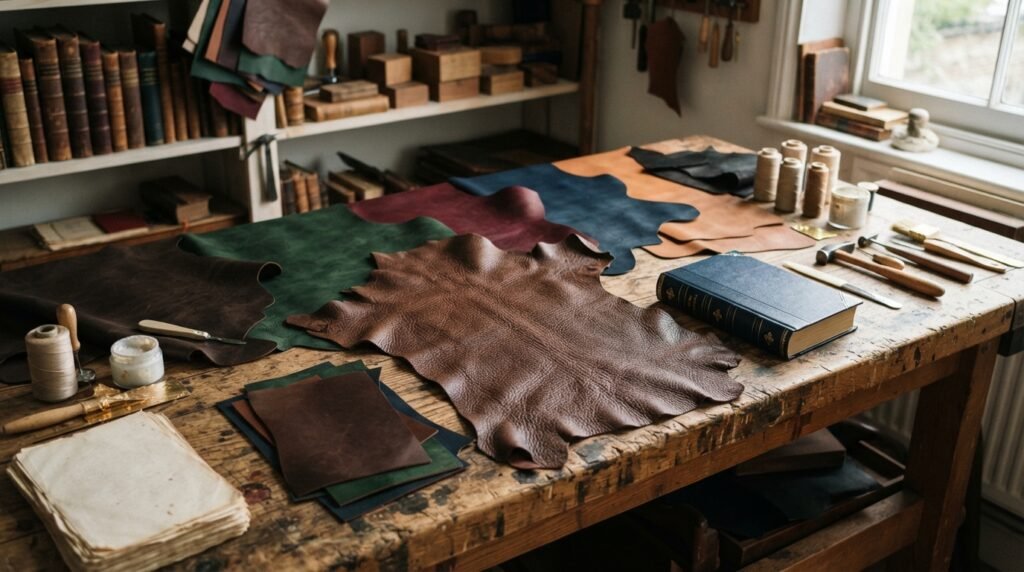
Bookbinding leather used for ledgers, presentation books, and premium hardbound gift sets has the longest performance requirement of the three categories, since bound leather items are often intended as keepsakes rather than daily-use tools.
Vegetable-tanned goat and calf leather remain the historical standard in fine bookbinding because of their fine, tight grain and the way they pare down evenly at the edges during binding a requirement that coarser hides can’t meet without cracking. Split leather with a finished top coat is sometimes used for lower-cost bookbinding runs, though it lacks the longevity and edge-paring quality of full-grain material, so it’s better suited to shorter production runs or promotional-tier gifts rather than heirloom-positioned pieces.
Bookbinding leather is typically supplied thinner than portfolio leather often in the 0.6–1.0mm range since it needs to fold cleanly around spines and corners without adding bulk to the finished book block.
Comparing the Three Applications
| Application | Recommended Leather | Typical Thickness | Key Property Needed |
| Portfolios | Full-grain / top-grain / pebble-grain | 1.2–1.6mm | Structure, scuff resistance |
| Diaries & notebooks | Vegetable-tanned / nubuck / aniline | 0.8–1.2mm | Flexibility at spine, clean embossing |
| Bookbinding | Vegetable-tanned goat/calf, split leather | 0.6–1.0mm | Fine grain, even edge-paring |
Color and Finish Options for Brand Alignment
Most corporate gifting programs need the leather to align with a brand’s color palette, not just perform mechanically. Vegetable-tanned leather takes aniline and semi-aniline dyes well, which allows for a broad range of custom colors while still preserving natural grain character useful for brands whose identity relies on a specific shade rather than standard black, brown, or tan. Pigmented finishes, by contrast, offer tighter color consistency across large batches and are more forgiving of natural hide variation, which makes them a practical choice when an order needs several thousand units to match within a narrow tolerance.
Matte finishes remain the default for executive gifting since they read as understated and premium, while a light satin or semi-gloss top coat is sometimes requested for diary lines aimed at a younger or more fashion-forward recipient base. Whatever the finish, buyers should request a physical swatch card rather than relying on digital color references, since leather dye can shift noticeably in appearance under different lighting.
Branding and Customization Considerations
Corporate gifting orders almost always require logo branding, and not every leather takes it equally well. Vegetable-tanned and full-grain leathers hold heat-stamped and blind-embossed logos most cleanly because their denser fiber structure holds the pressed impression without springing back. Heavily pigmented or coated leathers can resist debossing and are generally better suited to foil-stamped branding instead. Buyers sourcing for large gifting programs should request branding samples on the actual hide batch before committing to a full production run, since embossing depth and clarity can vary between tanneries and even between batches from the same tannery.
It’s also worth deciding on a branding approach before finalizing the leather choice rather than after, since some techniques constrain the material more than others. Debossing needs a thicker, denser hide to hold a crisp impression; foil stamping works across a wider range of leathers but shows less texture depth; and laser engraving, increasingly common for minimalist branding, performs best on lighter, uncoated finishes where the burn mark reads cleanly against the surface.
Sourcing Considerations for Bulk Corporate Gifting Orders
Corporate gifting programs are typically ordered in batches timed around fiscal year-end, conferences, or client anniversaries, which means consistency and lead time matter as much as the leather itself. Buyers should confirm batch-to-batch color and grain consistency before ordering at volume, since a portfolio line with visible shade variation across units undermines the premium positioning the gift is meant to convey. It’s also worth confirming whether the tannery can supply pre-cut panels sized to the buyer’s die-cutting specifications, which reduces waste and shortens the manufacturer’s production timeline.
Lead time is often the deciding factor for gifting programs tied to a fixed event date. Vegetable-tanned leather, because of its longer tanning process, typically needs to be ordered further in advance than chrome-tanned alternatives, so buyers working toward a conference or year-end deadline should build that extra time into their production schedule rather than assuming all leather types ship on the same timeline. Requesting a production calendar upfront, including dyeing, finishing, and quality-control stages, helps avoid last-minute compression that can affect finish quality.
Sustainability credentials are increasingly part of corporate gifting procurement as well, particularly for programs run by companies with public ESG commitments. Leather Working Group (LWG) certification and documented chrome-free or vegetable-tanned options give gifting brands a sourcing story they can point to if asked about the environmental footprint of the gift.
Helping Recipients Get the Most From Their Gift
A small but often overlooked part of a corporate gifting program is what happens after the item ships. Leather portfolios and diaries that are properly cared for hold their appearance and branding far longer, which extends the amount of time the gift keeps reinforcing the giving brand every time it’s used. Simple guidance keeping leather away from prolonged direct sunlight and moisture, wiping spills promptly rather than letting them soak in, and conditioning full-grain or vegetable-tanned pieces every several months is inexpensive to include as an insert card and adds a further touch of perceived quality to the unboxing experience. Some gifting programs include this as a printed care card inside the packaging, which also reinforces the premium positioning of the item itself.
Why Source Corporate Gifting Leather from Akram Tannery
Akram Tannery has operated out of Kasur, Pakistan since 1990, supplying finished, vegetable-tanned, and specialty leathers to international buyers across fashion, accessories, and stationery categories. For corporate gifting programs specifically, the tannery can supply full-grain and vegetable-tanned hides in the thickness ranges needed for portfolios, diaries, and bookbinding, with batch consistency maintained across repeat orders a requirement for any brand running an annual or recurring gifting program rather than a one-time order.
Buyers working with Akram Tannery can request custom color matching, pre-cut panel sizing to reduce downstream waste, and branding samples on production-batch hide ahead of full manufacturing runs, which helps gifting programs stay on schedule without compromising on finish quality.
Ready to Source Leather for Your Next Corporate Gifting Program?
Whether you’re planning an executive portfolio line, a branded diary set for client appreciation, or a bound presentation book for a milestone event, choosing the right leather upfront saves time and rework later in production. Get in touch with Akram Tannery to request swatches, discuss thickness and finish options for your application, and set a production timeline that fits your event date.
Frequently Asked Questions
What’s the best leather for a corporate gift portfolio?
Full-grain or top-grain leather in the 1.2–1.6mm range is typically recommended, since it holds structure and takes logo branding cleanly.
Why is vegetable-tanned leather preferred for diaries?
It embosses and stamps more cleanly than chrome-tanned leather and develops an attractive patina over time, which suits the long-use nature of a diary.
Can corporate gifting leather be sourced with sustainability certifications?
Yes LWG-certified and vegetable-tanned, chrome-free leather options are available and increasingly requested by procurement teams with ESG reporting requirements.
What thickness should I request for bookbinding leather?
Generally 0.6–1.0mm, thin enough to pare cleanly at spines and corners without adding bulk.
How do I make sure branding looks consistent across a large gifting order?
Request a branding sample on the actual production batch before committing to full-volume manufacturing, since embossing clarity can vary by hide and batch.
How far in advance should I order leather for a gifting program tied to a fixed event date?
Build in extra lead time for vegetable-tanned leather specifically, since its longer tanning process means it typically needs to be ordered further ahead than chrome-tanned alternatives.