
When you think about military equipment that soldiers depend on in the toughest conditions imaginable, leather might not be the first material that comes to mind. Yet for centuries, military leather has been and continues to be one of the most trusted materials in defense equipment. From combat boots to tactical holsters, from military bags to equipment straps, leather plays a critical role in keeping soldiers protected, mobile, and effective.
The difference between regular leather and military grade leather isn’t just about quality; it’s about survival. When you’re crossing desert terrain, moving through heavy mud, or operating in sub-zero temperatures, your gear must perform without fail. That’s why defence contractors, military procurement teams, and tactical gear manufacturers place such high importance on sourcing the right types of leather for their equipment.
This comprehensive guide explores exactly which leather types dominate military and defense applications, why they’re chosen, and what makes them capable of withstanding the extraordinary demands placed on military equipment.
Why Military Equipment Demands Special Leather?
Civilian gear just needs to look good. Military gear survives sandstorms, freezing nights, scorching days, 100kg loads, chemicals, and saltwater, for years.
Regular leather cracks or rots. Military leather gets tested to endure more than 5 years of combat.
It’s not about style. It’s about survival.
Soldiers might march 20 miles carrying 80 pounds of gear. Combat boots get submerged in swamps, baked in deserts, and frozen in mountains, sometimes all in the same deployment. Tactical gear takes constant abuse from rough handling, extreme weather, and exposure to chemicals, fuels, and oils.
Beyond durability, military leather must meet specific defense standards. Most military contracts require leather that passes rigorous testing for tensile strength, abrasion resistance, water resistance, and dimensional stability. The material can’t fall apart when exposed to standard military cleaning chemicals or lubricants. It needs to remain functional across temperature ranges from minus 40 to 120 degrees Fahrenheit.
Weight matters tremendously in military applications. Every ounce a soldier carries affects mobility, fatigue, and mission effectiveness. Military boot leather and tactical equipment leather must provide maximum protection and durability while keeping weight as low as possible.
Finally, there’s the issue of break-in time and comfort. New soldiers can’t spend weeks breaking in boots during basic training. Military grade boots need to be comfortable relatively quickly while still offering the structural support needed for carrying heavy loads across rough terrain.
Full Grain Leather: The Gold Standard for Combat Boots
Walk into any military surplus store or examine standard-issue combat boots, and you’ll almost certainly see full-grain leather. This material has dominated military footwear for decades, and for excellent reasons.
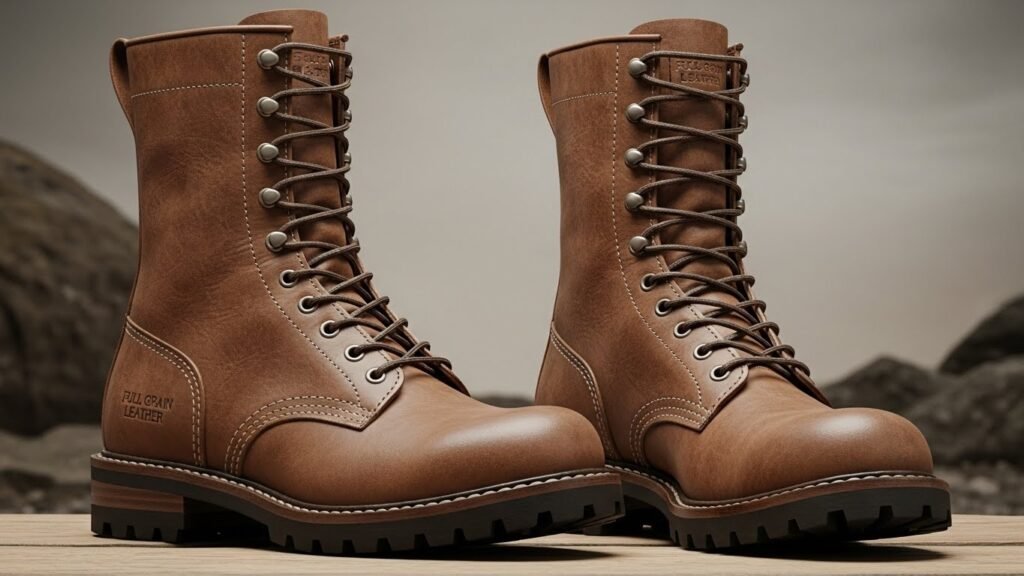
Full-grain leather comes from the top layer of the hide with nothing sanded away or buffed out. You see every natural marking, pore, and characteristic that makes each hide unique. This sounds like a quality compromise, but it’s what makes full-grain leather incredibly strong.
The top layer of an animal’s hide contains the tightest, most densely packed fibers. These fibers create a material that resists tearing, puncturing, and abrasion better than any other natural leather. When you’re wearing military boots while navigating rocky terrain or barbed wire, this matters enormously.
Why Full Grain Dominates Military Footwear
For army boots, Marine Corps boots, and other service branch footwear, full-grain leather offers unmatched durability. Modern military combat boots made with quality full-grain leather can withstand hundreds of miles of hard use before requiring replacement.
The material naturally resists water better than processed leathers. While not waterproof on its own, full-grain leather’s tight fiber structure prevents water from penetrating quickly. This gives manufacturers time to add waterproof membranes without compromising the leather’s breathability.
Full-grain combat boots also develop what soldiers call “character” over time. Rather than looking worn out and shabby after months of use, properly maintained full-grain leather develops a rich patina. The boots actually look better and feel more comfortable the longer you wear them.
Another advantage for military applications is repairability. Full-grain leather is thick enough that skilled cobblers can restitch seams, replace soles, and make repairs that would be impossible with thinner leathers. This extends boot life significantly, an important factor when supply lines are stretched or budgets are tight.
Flesh-Side-Out Leather in Modern Military Boots
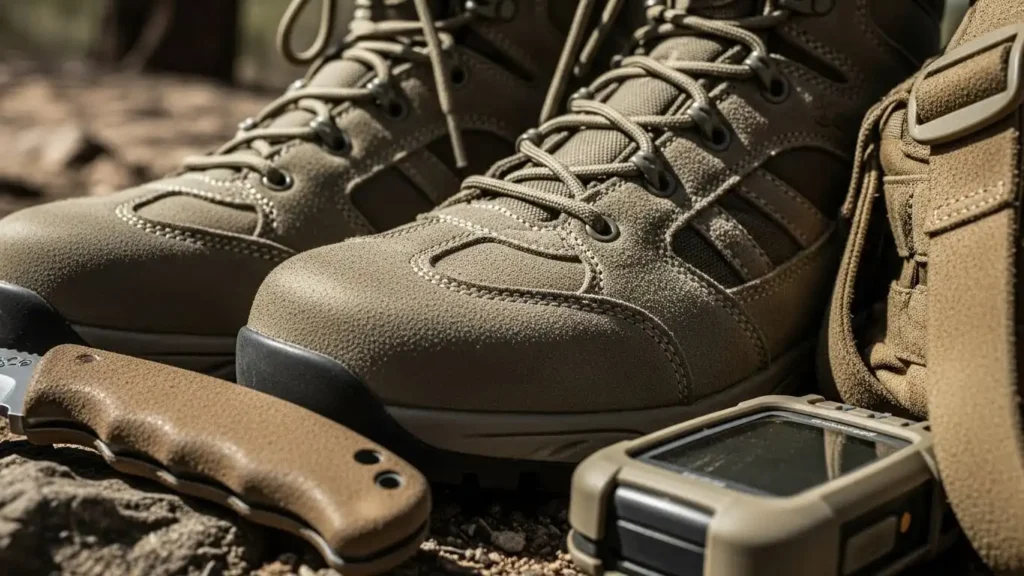
You’ll notice many modern military tactical boots use leather that looks suede-like on the outside. This is flesh-side-out cattlehide leather, sometimes called rough-out leather. It’s actually full-grain leather turned inside out, so the rough underside becomes the exterior.
Why this seemingly backwards construction? The rough surface actually offers several tactical advantages. It’s less reflective than smooth leather, helping with camouflage and reducing the chances of giving away a position through boot shine. The rough texture also grips slings, straps, and rope better than smooth leather.
Flesh-side-out leather takes boot polish differently than smooth leather, creating a more matte finish preferred in tactical situations. It’s also incredibly durable; the same tough fibers that make full grain strong are now on the exterior, where they directly resist abrasion.
The AR 670-1 standard for U.S. Army boots specifically requires coyote brown flesh-side-out cattlehide leather for uniform wear with OCP uniforms. This specification shows how flesh-side-out full-grain leather has become the military standard.
Top Grain Leather: The Practical Alternative
While full-grain leather dominates heavy-duty applications, top-grain leather finds extensive use in military equipment, where slightly less durability is acceptable in exchange for other benefits.
Top grain leather starts as full grain, but the very top surface is lightly sanded to remove imperfections. Then a protective finish is applied. The result is leather that’s more uniform in appearance and slightly more flexible than full grain.
For military bags, tactical pouches, and certain types of holsters, top-grain leather offers excellent performance. It’s easier to work with during manufacturing, which matters when producing equipment at scale for military contracts.
Military holsters for sidearms often use top-grain leather because the material molds well to specific weapon shapes while maintaining structural integrity. The slightly softer feel compared to full grain means holsters require less break-in time soldiers can draw their weapons smoothly from day one.
The protective finish applied to top-grain leather also makes it easier to clean and maintain. For military tactical gear that regularly encounters mud, dust, or vehicle fluids, this advantage helps soldiers keep their equipment functional with minimal maintenance time.
Vegetable Tanned Leather: Traditional Strength
While most modern military leather goods use chrome tanning, vegetable-tanned leather maintains a place in certain military applications, particularly for traditional military equipment and ceremonial gear.
Vegetable tanning uses natural tannins from tree bark and takes months to complete. The resulting leather is firmer initially but develops superior strength characteristics over time. Most importantly, vegetable-tanned leather can be shaped through tooling and molding techniques impossible with chrome-tanned leather.
Applications in Military Gear
Military saddles and cavalry equipment traditionally used vegetable-tanned leather because it could be formed into complex shapes and would hold those shapes under stress. While cavalry units are now largely ceremonial, military police mounted units still use equipment made from this traditional leather.
Ceremonial military dress belts, parade boots, and leather accouterments often feature vegetable-tanned leather because it takes a brilliant polish and ages beautifully. The material develops a deep, rich patina that chrome-tanned leather can’t match.
Some specialized military knife sheaths and sword scabbards still use vegetable-tanned leather, particularly for special forces and honor guard units. The leather can be wet-molded to fit specific weapons perfectly, creating custom-fitted carry solutions.
Historical reenactment equipment for military museums and ceremonial units relies heavily on vegetable-tanned leather to maintain authenticity.
Chrome Tanned Leather: Modern Military Standard
The vast majority of contemporary military equipment leather is chrome-tanned. This process uses chromium salts and produces leather in days rather than months. For modern military procurement needs, chrome tanning offers compelling advantages.
Chrome-tanned leather is softer and more flexible from the start. Military gloves, certain tactical boots, and equipment straps benefit from this immediate pliability. Soldiers don’t need extended break-in periods for chrome-tanned gear.
The material resists water and chemicals better than vegetable-tanned leather. Military tactical equipment frequently encounters fuel, oils, and cleaning solvents. Chrome-tanned leather holds up better against these exposures.
Chrome tanning also produces more consistent results across batches. When the Department of Defense orders 50,000 pairs of combat boots, consistency matters. Chrome-tanned leather ensures all those boots perform similarly regardless of which specific hides were used.
Specialized Military Applications
Military flight boots and pilot gear often use chrome-tanned leather for its fire resistance properties. The material resists ignition better than some alternatives and doesn’t produce toxic fumes as quickly as synthetic materials.
Cold-weather military boots frequently combine chrome-tanned leather outers with specialized insulation. The leather’s natural properties help regulate moisture, while the flexible nature accommodates the extra insulation layers needed for extreme cold protection.
Tactical gloves for military use almost exclusively use chrome-tanned leather because finger dexterity and immediate flexibility are crucial. Soldiers need to manipulate weapons, equipment, and communications gear while wearing gloves; stiff leather isn’t an option.
Cowhide: The Workhorse of Military Leather
When military specifications call for leather without specifying exotic options, it’s almost always cowhide leather. This ubiquitous material dominates military gear production for practical and economic reasons.
Cowhide is readily available in quantities needed for military contracts. When a procurement order calls for tens of thousands of military boots or tactical equipment pieces, cowhide suppliers can meet these demands where exotic leather sources would struggle.
The material offers an excellent balance of strength, flexibility, and cost. While exotic leathers might outperform cowhide in specific characteristics, cowhide excels across all performance categories relevant to military use without premium pricing.
Military grade cowhide meeting defense specifications provides tensile strength exceeding 2,000 PSI, with abrasion resistance that allows boots to survive 6-12 months of combat deployment. The leather remains flexible down to -20°F and maintains structural integrity up to 140°F.
Types of Cowhide in Military Use
Cattlehide leather specifically refers to cowhide from cattle raised primarily for meat production. These hides tend to be thicker and more durable than dairy cow hides. Most military combat boots use cattlehide because of its superior toughness.
Steerhide (from castrated male cattle) offers the thickest, most durable cowhide. Some premium military boots and heavy-duty equipment straps use steerhide when maximum durability outweighs cost concerns.
Bull hide is even thicker than steerhide but less commonly used in military gear because it’s stiffer and requires more processing. Some military saddles and extremely heavy-duty gear might incorporate bull hide for maximum longevity.
Nubuck and Suede: Specialized Military Applications
While smooth leather dominates military gear, nubuck leather and suede have specific roles in defense equipment.
Nubuck is top-grain leather that’s been sanded or buffed on the outer surface to create a slight nap. The result feels like very fine velvet but retains most of the durability of the underlying top grain leather. Some military desert boots use nubuck because the material breathes well and handles sand better than smooth leather.
The textured surface of nubuck hides scuffs and scratches better than polished leather. For military tactical boots that will never see parade duty, this means less maintenance time and gear that looks serviceable longer.
Suede leather (made from the underside of the hide) appears in some military cold-weather gear and certain tactical equipment. The material’s softness makes it comfortable against skin, useful for military glove liners or equipment that contacts the body directly.
However, suede’s reduced durability means it’s always used in combination with tougher materials. You might find suede panels in military boots for flexibility at ankle articulation points, but never as the primary outer material in heavy-wear areas.
Synthetic Leather: The Modern Alternative
While this article focuses on genuine leather, it’s worth noting that synthetic military leather (often made from polyurethane or PVC) has gained ground in certain military applications.
Vegan military boots and synthetic tactical gear offer advantages in specific scenarios. The material is completely waterproof without treatment, lighter than comparable genuine leather, and requires less maintenance. For troops operating in extremely wet environments, synthetic alternatives sometimes outperform traditional leather.
However, synthetic materials generally lack the durability and repairability of genuine leather. They don’t breathe as well, leading to moisture and odor issues during extended wear. Most importantly, synthetic materials tend to fail catastrophically when they break; they’re done. Leather usually shows gradual wear, giving soldiers a warning before complete failure.
The U.S. military permits synthetic military boots as long as they meet strict performance standards, but many soldiers still prefer genuine leather because of its proven durability, comfort, and reliability during long deployments.
Leather Requirements in Military Specifications
Understanding military leather specifications helps explain why certain leather types dominate defense equipment. The U.S. military publishes detailed material specifications that suppliers must meet for contract eligibility.
MIL-DTL-5009 covers general requirements for leather used in military gear. This specification mandates minimum tensile strength, tear strength, and elongation values. Military leather resists chemicals (fuels, oils, cleaners) and stays flexible from -40°C to +60°C.
Boots follow strict rules: AR 670-1 dictates exact specs for each uniform. Every branch has similar standards.
The wrong material is a result of failed inspection, and as a result, the soldiers get unreliable gear.
Precision saves lives.
These specifications typically require:
- Specific leather types (usually full-grain cattlehide)
- Precise color requirements (coyote brown, black, or tan)
- Minimum thickness measurements (typically 1.6-2.0mm for boot uppers)
- Water resistance standards
- Abrasion resistance minimums
Berry Amendment compliance is also very important. This law requires that leather used in military equipment must be made in the United States using U.S. hides. Because of this rule, only certain types of leather qualify for military contracts.
Important Quality Factors for Military Leather
Beyond the leather type, several quality factors decide whether the material meets military-grade standards.
Thickness and Consistency
Military leather must have the same thickness across the whole hide. If the thickness changes in different areas, it can create weak spots that may tear or wear out quickly during tough use.
Quality military leather suppliers measure thickness at multiple points and reject hides with excessive variation.
For combat boot leather, typical specifications call for 1.8-2.0mm thickness. Thicker than this adds unnecessary weight. Thinner compromises durability. Premium suppliers maintain ±0.1mm tolerance across the entire hides.
Tensile Strength
This measures how much pulling force the leather can withstand before tearing. Military leather typically requires a minimum tensile strength of 2,000-2,500 PSI. Higher quality leathers exceed 3,000 PSI.
For military straps, equipment slings, and tactical harnesses, tensile strength directly correlates to load-bearing capability and safety margins.
Tear Resistance
Different from tensile strength, tear resistance measures how leather performs when already cut or punctured. Military grade leather must resist tear propagation a small cut shouldn’t easily extend into a complete failure.
This matters enormously for combat boots encountering barbed wire or sharp debris. A puncture shouldn’t mean the entire boot fails.
Flexibility Retention
Leather that becomes stiff and brittle fails in military applications. Military leather must retain flexibility through temperature extremes, repeated wetting and drying, and exposure to military chemicals and lubricants.
Quality testing subjects leather samples to accelerated aging, simulating years of use in weeks, then measures whether the material still flexes appropriately.
Abrasion Resistance
Military operations guarantee leather will scrape against rough surfaces constantly. Military boot leather undergoes standardized abrasion testing using wire wheels or abrasive cloths under controlled conditions.
Premium military leather shows minimal material loss even after thousands of abrasion cycles.
Specialized Military Leather Applications
Different military equipment types demand specific leather characteristics.
Combat and Tactical Boots
Military combat boots are the biggest use of leather in defence gear. Modern combat boots usually include:
- Full-grain or flesh-side-out leather on the upper part for strong durability
- 8–10 inch boot height to provide ankle support and protection
- Water-resistant treatment or waterproof membrane integration
- Abrasion-resistant toe caps and heel counters
- Coyote brown or black color, depending on uniform standards
Different operational environments require variants. Desert combat boots use lighter leather with maximum breathability. Jungle boots incorporate drainage and quick-drying features. Insulation and moisture control are qualities of Cold-weather Boots.
Military Holsters and Weapon Accessories
Tactical holsters for military sidearms traditionally used leather, though modern materials have made inroads. Leather military holsters still offer advantages:
- Natural friction that secures weapons without complex retention mechanisms
- Ability to mold to specific weapon shapes
- Quiet operation without clicking or squeaking
- Resistance to cracking and splitting under stress
Knife sheaths, bayonet scabbards, and rifle slings continue to use leather extensively. The material holds weapons firmly, protects their edges from damage, and works quietly, which is very important for tactical operations.
Military Bags and Carrying Equipment
Military duffel bags, tactical backpacks, and equipment pouches often use leather reinforcements, even if the main material is canvas or nylon.
Leather military gear handles stress points, shoulder strap attachment, bottom corners, and handle areas where synthetic materials would quickly fail.
Military saddles for mounted units use extensive leather construction. Modern military police mounted patrols and ceremonial cavalry units maintain traditional leather saddles requiring craftsmen who understand both leatherworking and equine equipment.
Military Gloves and Protective Gear
Tactical gloves for military use balance protection with dexterity. Leather military gloves typically feature:
- Chrome-tanned cowhide or goatskin palms for grip and durability.
- Reinforced finger and knuckle protection
- Touchscreen-compatible fingertips on modern versions
- Moisture-wicking liners for comfort
Specialized applications like military flight gloves, combat vehicle gloves, and cold weather military gloves each have unique leather requirements balancing protection, flexibility, and environmental resistance.
Caring for Military Leather Equipment
You can extend the life of Military gear effectively with proper care.
Cleaning Military Leather
Military boot care starts with removing dirt and debris after each use. A damp cloth handles light cleaning. For heavily soiled gear, saddle soap or military-approved leather cleaners remove grime without damaging the material.
Never use harsh chemicals, gasoline, or solvents. These destroy the leather’s natural oils and protection, making it wear out fast.
Conditioning and Waterproofing
Leather naturally contains oils that keep it supple. Use these oils over time. Military leather conditioning replaces them using mink oil, leather conditioner, or military-issue treatments.
Water-resistant leather needs regular waterproofing. Use silicone sprays, wax treatments, or oil-based waterproofers. Check what your gear manufacturer recommends before treating.
Storage and Long-Term Care
When not in use, military leather equipment should be stored in cool, dry conditions with good airflow. Avoid plastic bags that trap moisture and promote mildew.
Stuff military boots with newspaper or boot trees to maintain shape. Clean and condition leather before storage. Check stored equipment periodically for signs of mildew or insect damage.
The Future of Military Leather
Military equipment continues evolving, but leather in defense applications shows remarkable staying power. While advanced synthetic materials work very well for certain uses, leather’s unique combination of qualities is still hard to fully copy.
Modern innovations aim to improve leather instead of replacing it. Nano-coatings make leather more water- and stain-resistant without affecting breathability. Hybrid designs combine leather’s strengths with the benefits of synthetic materials.
Environmental concerns are driving interest in more sustainable military leather. Vegetable tanning methods are being refined for faster production. Chromium-free tanning alternatives are gaining military approval as they meet performance standards while reducing environmental impact.
Smart leather incorporating sensors and communication technology represents another frontier. Experimental military boots with embedded sensors monitor soldier’s health and location. Tactical gloves with conductive threads allow equipment operation while maintaining the leather’s protection.
Frequently Asked Questions About Military Leather
What type of leather is best for military boots?
Full-grain cattlehide leather, particularly flesh-side-out (rough-out) leather, is the military standard for combat boots. This leather offers maximum durability, good water resistance, and the ability to withstand extreme conditions. The flesh-side-out version reduces reflectivity for tactical advantage while providing excellent abrasion resistance. Most U.S. military boots meeting AR 670-1 standards use this leather type.
Why do military boots use rough leather instead of smooth?
Rough-out or flesh-side-out leather offers several tactical advantages over smooth leather. The textured surface is less reflective, helping with camouflage and operational security. It grips rope and webbing better, takes a matte finish preferred in field operations, and actually places the toughest part of the leather on the exterior, where it directly resists abrasion and wear.
How long do military leather boots last?
Quality military combat boots made from full-grain leather typically last 6-12 months of daily combat deployment, or 2-4 years of regular garrison duty. Lifespan depends heavily on usage conditions, maintenance quality, and terrain. Properly cared-for boots in non-combat situations can last 5+ years. The military’s emphasis on quality leather ensures boots survive demanding conditions that would destroy inferior materials quickly.
What is military grade leather?
Military grade leather refers to leather meeting specific Department of Defense specifications for strength, durability, and performance. These specifications (like MIL-DTL-5009) mandate minimum tensile strength (typically 2,000+ PSI), specific thickness tolerances, abrasion resistance standards, and chemical resistance requirements. Military grade leather must also meet Berry Amendment compliance, requiring U.S. production from domestic hides.
Can military leather equipment get wet?
Yes, military leather can handle some moisture, but it is usually water-resistant, not fully waterproof. Full-grain leather naturally keeps out water, and most military gear gets extra water-resistant treatments. However, if leather is submerged for a long time, untreated areas will eventually get wet. Many modern military boots incorporate waterproof membranes behind the leather for complete water protection while maintaining breathability.
What makes military holsters better than civilian leather holsters?
Military tactical holsters use thicker, more durable leather (typically 8-10 ounce weight versus 5-7 ounce for civilian holsters) and are built to survive extreme abuse. They undergo testing for retention under stress, durability through thousands of draw cycles, and resistance to environmental factors. Military holsters also feature reinforced stitching, metal hardware resistant to corrosion, and designs that secure weapons through rough handling that civilian holsters never encounter.
Why is full-grain leather preferred over top-grain for military use?
Full-grain leather contains the hide’s tightest, strongest fiber structure in the top layer, making it more durable and abrasion-resistant than top-grain leather (which has this layer partially removed). Full grain develops a protective patina over time and actually becomes more water-resistant with use. For military applications where equipment must survive harsh conditions and extended use, full grain’s superior durability justifies any additional cost or break-in time.
How do you maintain military leather gear in the field?
To care for military leather in the field, remove dirt and dust daily with a damp cloth. Let wet gear dry naturally, away from direct heat. Apply leather conditioner every 2–4 weeks, depending on conditions. Keep leather away from oils and fuels, as they can damage it. If boots get soaked, stuff them with newspaper to soak up moisture and keep their shape.. Regular conditioning prevents leather from drying and cracking in harsh environments.
Get Military-Quality Leather for Your Defense Equipment Needs
Choosing the right leather for military and defense applications isn’t just about finding tough material; it’s about sourcing leather that will protect lives and complete missions in the world’s harshest environments. Whether you’re a defense contractor, military procurement officer, or tactical gear manufacturer, the leather you select directly impacts the safety and effectiveness of the personnel using your equipment.
At Akram Tannery, we understand the exacting standards that military and defense applications demand. With decades of experience producing premium quality leather, we’ve supplied material for tactical equipment, military footwear components, and defense gear that meets and exceeds military specifications.
Our full-grain leather, premium cowhide, and military-grade leather are made to be consistent, durable, and perform as required for defense use.
From combat boot leather to tactical equipment materials, our range includes the leather types discussed throughout this guide. Every hide is inspected for quality, tested for performance, and selected to ensure it meets the demanding requirements of military use.
Ready to discuss your military leather requirements? Whether you’re sourcing leather for a defence contract, making new tactical gear, or need reliable leather for military-spec equipment, our team has the expertise and quality you need.
Visit akramtannery.com today to explore our military-grade leather, request samples, or talk about your specific project requirements.
When lives depend on your equipment, trust leather from a supplier who understands what military grade really means. Contact Akram Tannery where quality meets mission-critical reliability.