
Choosing the right leather supplier is one of the most consequential decisions you’ll make when launching or scaling a leather goods business. Whether you’re sourcing hides for handbags, wallets, footwear, upholstery, or leather backpacks, the supplier you choose determines your product quality, your production timelines, your margins, and ultimately your brand’s reputation. A bad first order inconsistent hides, hidden defects, missed deadlines or a supplier who disappears after payment can set a new business back months and burn through capital that’s hard to recover.
Unlike many other raw materials, leather is not a standardized commodity. Every hide is a natural product with variation in thickness, grain, color, and finish, which means supplier evaluation has to go deeper than checking a price sheet. This guide walks through exactly how to evaluate a leather supplier before placing your first order, covering leather types and grades, supplier vetting, sample testing, pricing structures, logistics, ethical sourcing, and the red flags that should make you walk away.
Why Supplier Evaluation Matters More in Leather Than Other Materials
Leather sourcing carries risks that don’t exist with more standardized materials like synthetic fabric or plastic components. Hides vary naturally from animal to animal, tanning processes differ from tannery to tannery, and terminology is used inconsistently across regions and suppliers. A supplier’s idea of “genuine leather” or “top-grain leather” might not match your definition, and by the time you discover the mismatch, you may already have a shipment of unusable material.
Beyond quality consistency, leather sourcing also touches on ethical and regulatory issues, animal welfare standards, tannery environmental practices, and country-of-origin regulations that can affect your ability to import or sell in certain markets. A thorough supplier evaluation process protects you from quality problems, supply chain disruptions, compliance issues, and reputational risk down the line.
Step 1: Understand Leather Types and Grades Before You Start
Before you can evaluate any leather supplier, you need a clear understanding of the terminology, because suppliers don’t always use it consistently.
- Full-grain leather: The top layer of the hide with the natural grain intact, minimally processed. The most durable and highest quality, but also the most expensive.
- Top-grain leather: The top layer sanded down and refinished, more uniform in appearance but slightly less durable than full-grain.
- Genuine leather: A confusingly named grade that’s actually lower quality made from leftover layers of the hide, often heavily processed and coated.
- Bonded leather: Scraps of leather fiber bonded together with adhesive, the lowest quality tier, often used for budget products.
- Split leather: The lower layers of the hide, often used for suede or as a base for coated finishes.
- Vegetable-tanned vs. chrome-tanned leather: Refers to the tanning process. Vegetable tanning uses natural tannins and produces a firmer leather that develops a deep patina over time, while chrome tanning uses chemical salts and produces a softer, more consistent, and more water-resistant leather more quickly.
Knowing these distinctions matters because a supplier quoting “genuine leather” at a full-grain price is either misinformed or misrepresenting their product and you won’t catch that discrepancy unless you know what to ask for and what to look for in a sample.
Step 2: Verify the Supplier’s Legitimacy
Before discussing product details, confirm that you’re dealing with a real, established business. This is especially important when sourcing internationally, where verifying legitimacy is harder and scams are more common.
- Business registration: Ask for business licenses, registration numbers, or tax identification. Cross-check these against your country’s or the supplier’s country’s business registry where possible.
- Years in operation: A supplier with a decade of operating history and a track record of ongoing client relationships carries less risk than a brand-new operation with no verifiable history.
- Physical facility verification: Request photos or video of the actual tannery or warehouse, or better yet, arrange a video call walkthrough. Reverse image search any photos they send to confirm they aren’t stock images or images lifted from a competitor’s website.
- Trade references: Ask for two or three references from existing clients, ideally ones who have been ordering from the supplier for at least a year. A legitimate supplier should have no issue connecting you with satisfied customers.
- Third-party verification services: Platforms like Alibaba’s Verified Supplier program, SGS inspections, or industry-specific trade associations can provide an added layer of confirmation, particularly for suppliers you haven’t worked with before.
- Online presence and reviews: Check the supplier’s website, industry directories, and platforms like Trustpilot or B2B marketplaces for independent reviews. Be cautious of suppliers with no digital footprint at all, as well as those with suspiciously uniform five-star reviews.
Step 3: Request and Rigorously Test Samples
No amount of photos, specification sheets or sales pitches can replace physically handling the leather. Sample testing is the single most important step in supplier evaluation, and it’s where many first-time buyers cut corners to save time or money, a mistake that often costs far more later.
When requesting samples, ask for:
- Multiple hides from different batches, not just one cherry-picked sample, to assess consistency.
- The exact grade, thickness, and finish you intend to order in bulk, not a “similar” alternative.
- Both center-cut and edge-cut sections of the hide, since quality often varies across a single hide.
Once samples arrive, evaluate them across several dimensions:
- Grain consistency: Look closely at the surface for uniformity, natural markings, and any visible flaws like scarring or insect bites that go beyond typical natural character.
- Thickness and weight: Measure with calipers if precision matters for your product, and confirm it matches the ordered specification (leather thickness is typically measured in ounces or millimeters).
- Flexibility and hand-feel: Fold and flex the leather to check for cracking, stiffness, or an unnatural plastic-like feel that might indicate heavy coating or a lower grade than advertised.
- Smell test: Genuine, well-tanned leather has a distinct, rich, earthy scent. Overpowering chemical odors can indicate low-quality tanning or excessive coating.
- Water and stain resistance: If relevant to your product, test how the leather absorbs or resists a small drop of water to understand its finish characteristics.
- Colorfastness: Rub the surface with a white cloth to check whether dye transfers, which can indicate poor dye penetration or an unstable finish.
- Edge inspection: Examine cut edges to see the cross-section of the hide, which reveals whether it’s genuine full/top-grain or a bonded/split product with a printed finish layered on top.
Keep detailed notes and photos of each sample batch. If you move forward with the supplier, these become your quality benchmark for comparing future bulk shipments.
Step 4: Clarify Pricing Structure and Minimum Order Quantities
Leather pricing is rarely as simple as a flat per-unit rate and understanding the full cost structure upfront prevents unpleasant surprises later.
- Pricing basis: Leather is often priced per square foot, per hide, or per kilogram depending on the region and supplier. Confirm which basis is being used and convert it to a consistent unit for comparison across suppliers.
- Minimum order quantities (MOQs): First-time buyers should pay close attention to MOQs, since committing to a large volume before confirming consistent quality is a significant risk. Ask whether the supplier offers a smaller trial order before scaling up.
- Grading-based pricing tiers: Reputable suppliers typically offer tiered pricing based on grade (A, B, C, or similar), reflecting the natural variation in hide quality. Be wary of suppliers who only offer a single price regardless of visible quality differences.
- Payment terms: Understand deposit requirements, balance payment timing, and accepted payment methods. International wire transfers offer less buyer protection than letters of credit or trade assurance programs, so factor that into your risk assessment for a first order.
- Hidden costs: Ask specifically about tooling fees, minimum cutting charges, packaging costs, and any additional processing fees that might not appear in the initial quote.
Step 5: Assess Production Capacity and Lead Times
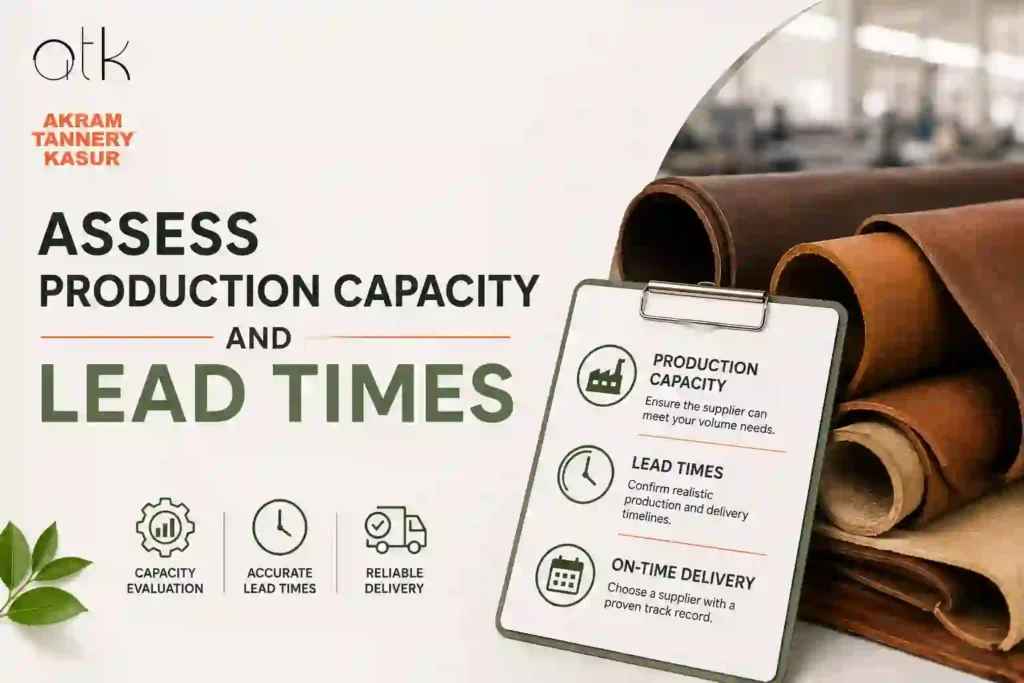
A supplier might produce excellent leather but still be a poor fit if their capacity or timelines don’t match your business needs.
- Current capacity utilization: Ask how much of their production capacity is already committed to existing clients, since an overbooked supplier may struggle to meet your deadlines.
- Typical lead times: Get specific numbers for sample production, bulk order production, and shipping, and build in buffer time for your first order in case of delays.
- Scalability: If you anticipate growing your order volume over time, ask directly whether the supplier can scale with you, or whether you’d eventually need to source from a larger operation.
- Quality control processes: Ask what internal QC steps the supplier has in place before shipment, visual inspection, thickness testing, colorfastness testing and whether they can share QC reports or photos before shipping.
Step 6: Evaluate Ethical and Environmental Sourcing Practices
Increasingly, leather buyers and their customers care about how hides are sourced and processed, and this due diligence protects both your supply chain and your brand.
- Tannery certifications: Look for certifications like the Leather Working Group (LWG) rating, which audits tanneries on environmental performance including water usage, chemical management, and waste handling.
- Traceability: Ask where the raw hides originate and whether the supplier can provide documentation tracing the material back to the tannery and, ideally, the region of origin.
- Chemical compliance: For markets with strict regulations (such as the EU’s REACH regulation), confirm the leather has been tested for restricted substances like chromium VI, azo dyes, and formaldehyde.
- Labor practices: Where possible, ask about working conditions at the tannery and any relevant labor certifications, particularly important if your own brand markets itself on ethical or sustainable sourcing.
Step 7: Communication and Responsiveness
How a supplier communicates during the evaluation process is often a reliable predictor of how they’ll behave once you’ve placed an order and money has changed hands.
- Response time: Slow or inconsistent responses during the sales process rarely improve after you’ve committed to an order.
- Clarity and detail: A supplier who answers technical questions about grain, tanning process, and thickness specifically and confidently is generally more trustworthy than one who gives vague, generic answers.
- Language and documentation: If you’re sourcing internationally, confirm that contracts, invoices, and specification sheets can be provided in a language and format you and your team can fully understand, to avoid costly misunderstandings.
- Willingness to put terms in writing: A supplier who resists formalizing pricing, specifications, or delivery timelines in a written agreement is a warning sign, regardless of how good their samples looked.
Step 8: Start With a Trial Order
Even after thorough evaluation, it’s wise to place a smaller trial order before committing to a full production run. A trial order lets you verify that:
- Bulk-shipped leather matches the quality of the samples you approved.
- The supplier meets the agreed lead time under real order conditions.
- Packaging and shipping protect the material adequately in transit.
- Invoicing, customs documentation (for international orders), and payment processes go smoothly.
Treat this first order as a test of the entire relationship, not just the material itself. Document everything, photos on arrival, measurements, any discrepancies from the sample so you have a clear record for future negotiations or disputes.
Red Flags to Watch For
Certain warning signs should make you pause or walk away entirely, even if the pricing looks attractive:
- Refusal to provide samples before a bulk order commitment.
- Pressure to pay the full amount upfront via untraceable payment methods.
- Vague or inconsistent answers about leather type, tanning process, or country of origin.
- No verifiable business registration or physical address.
- Prices significantly below market rate for the stated grade of leather, which often indicates misrepresented quality or bonded/synthetic material sold as genuine leather.
- Unwillingness to provide references or connect you with existing clients.
- Inconsistent sample batches with no explanation for variation.
Building a Long-Term Supplier Relationship
Once you’ve evaluated and successfully completed a trial order with a leather supplier, the relationship shouldn’t end there. The best supplier partnerships are built over multiple orders, with consistent communication, prompt payment, and clear feedback when issues arise. Many established suppliers offer better pricing, priority production slots, and more flexible terms to buyers who demonstrate reliability and clear communication over time.
It’s also worth maintaining relationships with more than one qualified supplier, even after finding one you trust. Having a backup supplier protects your production schedule against disruptions like capacity shortages, material shortages, or unexpected delays, which are common in the leather industry due to its dependence on natural, seasonal hide supply.
Final Thoughts
Evaluating a leather supplier before placing your first order is not a step to rush, even when you’re eager to get products into production. Understanding leather grades and terminology, verifying the supplier’s legitimacy, rigorously testing samples, clarifying pricing and lead times, and confirming ethical sourcing practices all work together to protect your business from costly mistakes. A leather supplier is a long-term business partner, not just a one-time transaction, and the diligence you put in before that first order sets the foundation for consistent quality, reliable timelines, and a supply chain you can build a brand on with confidence.
FAQs
What’s the difference between full-grain and genuine leather?
Full-grain leather is the top layer of the hide with the natural grain intact and is the highest quality tier. Despite the name, genuine leather is actually a lower grade made from leftover hide layers, heavily processed and coated to look uniform.
How much should a first trial order be?
There’s no universal number, but most buyers aim for a quantity large enough to test production consistency and shipping logistics while small enough to limit financial risk often a fraction of what a full production run would require. Ask the supplier directly what trial quantities they typically accommodate.
How do I know if a supplier is misrepresenting their leather grade?
Request samples and examine the cut edge of the hide, which reveals whether it’s genuine full or top-grain leather versus a bonded or split product with a printed finish. Pricing far below market rate for the stated grade is also a common indicator.
Is it safe to source leather internationally as a first-time buyer?
It can be, but it carries more risk than domestic sourcing due to language barriers, weaker payment protections, and harder-to-verify legitimacy. Using trade assurance programs, third-party inspections, and starting with a small trial order helps reduce that risk.
What certifications should I look for in an ethical leather supplier?
The Leather Working Group (LWG) rating is one of the most widely recognized certifications, auditing tanneries on environmental practices like water usage and chemical management. For regulated markets, also confirm compliance with chemical safety standards such as REACH.
How long does it typically take to receive leather samples?
This varies by supplier and location, but most reputable suppliers can turn around samples within one to three weeks. Significantly longer wait times with no clear explanation can be a sign of capacity or reliability issues.
Should I sign a contract for my first order?
Yes. Even a first trial order should have a written agreement covering specifications, pricing, quantities, delivery timelines, and payment terms. A supplier who resists formalizing these details in writing is a warning sign.
What’s the difference between vegetable-tanned and chrome-tanned leather?
Vegetable tanning uses natural tannins and produces a firmer leather that develops a rich patina over time, while chrome tanning uses chemical salts and produces a softer, more water-resistant leather more quickly. The right choice depends on your product’s intended look and durability needs.
Can I negotiate pricing on a first order?
Some room for negotiation often exists, particularly on larger volumes, but be cautious of suppliers who drop prices dramatically with little pushback, as this can indicate lower actual quality than advertised.
What should I do if a bulk shipment doesn’t match the approved sample?
Document the discrepancy immediately with photos and measurements, and raise it with the supplier in writing right away. Having a clear written agreement and sample benchmark from earlier in the evaluation process makes resolving these disputes far easier.