
The leather industry is in the middle of one of its most consequential stretches in decades. For most of the last generation, leather buyers could plan around fairly stable hide supply, predictable tanning costs, and a slow, steady shift toward sustainability. That era is over. In 2026, leather manufacturers, fashion houses, automotive OEMs, and furniture brands are navigating a market reshaped by raw hide shortages, tightening environmental regulation, shifting trade routes, and a consumer base that increasingly wants proof not promises of responsible sourcing.
For a business like Akram Tannery, a leather manufacturer based in Kasur, Pakistan, that has been exporting raw and finished leather to markets across the United States, the United Kingdom, Europe, the Gulf, and Asia-Pacific for more than three decades, these shifts aren’t abstract. They shape which hides are available, how vegetable-tanned and finished leather is priced, and which certifications a buyer in Milan or Los Angeles now expects to see before placing an order. This article breaks down where the global leather market stands in 2026, what’s driving the changes, and what buyers, brands, and manufacturers should be watching next. For a deeper look at the pricing and sourcing shifts specifically, see our companion piece on the global leather market outlook for 2026.
A Market That’s Growing, But Not Evenly
Depending on which research house you consult, the global leather goods market in 2026 sits somewhere between roughly $300 billion and $560 billion, with most mainstream estimates clustering around $500–530 billion and projections pushing past $850 billion by the early 2030s. The spread in numbers comes down to how each firm defines “leather goods” some include footwear and automotive upholstery, others focus narrowly on bags and accessories but the direction is consistent across every model: demand for genuine leather is still rising, even as the industry undergoes structural change.
What’s different in 2026 is that growth is no longer evenly distributed. It is concentrated in specific categories, specific regions, and specific types of leather.
Footwear remains the largest single application for leather worldwide, particularly in emerging economies where rising incomes are pushing consumers from synthetic to genuine leather shoes. Premium leather footwear priced above $200 is seeing especially strong performance, and artisan and boot categories are posting double-digit annual growth in several markets.
Automotive leather is the fastest-growing segment, with leather seating, steering wheel wraps, and interior trim projected to grow close to 9% annually through the early 2030s. As automakers lean into customization and premium interior packages to differentiate electric and hybrid vehicles, demand for consistent, high-grade upholstery leather has become a genuine competitive lever for OEMs, not just a luxury add-on.
Handbags, wallets, belts, and small leather goods continue to post steady growth, powered by fashion cycles and by luxury brands pushing further into Asia-Pacific, where a fast-growing middle class in China, India, and across Southeast Asia is fueling demand for premium leather accessories.
Regionally, Asia-Pacific is the fastest-growing market, driven by urbanization, rising disposable income, and expanding domestic fashion industries in China, India, and Japan. Europe still holds the largest share of global leather goods value, anchored by Italy and France’s status as centers of luxury leathercraft. North America is growing quickly too, propelled by e-commerce, direct-to-consumer luxury brands, and expanding demand in men’s leather fashion.
The Raw Hide Shortage Reshaping the Supply Chain
If there’s one structural issue defining the leather industry in 2026, it’s the tightening supply of raw hides. Leather is a byproduct of the beef and dairy industry tanneries don’t set cattle production levels, ranchers do, based on meat and milk economics that have nothing to do with leather demand. That disconnect is now creating real strain.
In the United States, cattle herd sizes have fallen to levels not seen since the 1950s, the result of years of drought, high feed costs, and herd liquidation among ranchers. Because hide supply is essentially “inelastic” rising leather prices don’t cause ranchers to raise more cattle the shortage isn’t correcting itself the way a normal commodity shortage might. Fewer cattle slaughtered simply means fewer hides on the market, regardless of how strong downstream demand is for finished leather, upholstery leather, or crust leather.
The knock-on effects are being felt throughout the supply chain:
- Premium hides those with minimal scarring, consistent thickness, and clean grain are becoming scarcer and more expensive, forcing tanneries and buyers to make hard choices between paying up for top-tier material, accepting lower grades, or exploring alternative materials for certain product lines. This is exactly why grading discipline matters so much right now see our guide on how to evaluate a leather supplier before placing your first order for what to check before you commit to a partner.
- Analysts are projecting leather footwear and accessories prices to rise roughly 22% through 2026–2027, driven by a combination of tariff impacts on major sourcing countries, higher freight costs, scarce premium hide availability, and rising environmental compliance costs at tanneries. Even after this adjustment period, a longer-term price increase of around 7% is expected to become the industry’s “new normal.”
- Major luxury groups have flagged the cost impact directly to investors. Companies that own well-known handbag and accessories brands have publicly cited tariff-related expenses running into the hundreds of millions of dollars, describing the pressure on margins as more significant than previously expected.
For buyers, this means the old approach of sourcing opportunistically from whichever supplier offers the lowest spot price is becoming riskier. Reliable, longer-term relationships with established tanneries the kind that can guarantee consistent grading, sorting by size and quality, and steady supply of vegetable-tanned, crust, and finished leather are becoming a genuine competitive advantage rather than a “nice to have.”
Sustainability Has Moved From Marketing to a Market Requirement
For years, “sustainable leather” was largely a marketing differentiator. In 2026, it has become closer to a market access requirement.
Leather Working Group (LWG) certification, which audits tanneries on water use, chemical management, energy efficiency, and traceability, has seen a sharp jump in adoption among luxury and automotive brands. Several major automakers have joined the certification push in the past year, signaling that leather sourced for premium vehicle interiors is now expected to carry documented, third-party-verified environmental credentials. Large retailers from major department stores to online luxury marketplaces are increasingly requiring LWG documentation before they’ll even list a supplier’s leather goods.
This is playing out alongside a genuine shift in consumer sentiment. Independent surveys now regularly find that close to half of consumers in North America and Europe say they favor eco-friendly leather over conventionally tanned alternatives when given the choice, and the “sustainable leather” segment is growing faster than the conventional leather market overall.
On the production side, this is translating into real operational changes at tanneries around the world:
- Chrome-free and vegetable tanning methods are gaining adoption despite longer processing times and higher input costs, because they eliminate the toxic chemical runoff associated with conventional chrome tanning. Our breakdown of sustainable tanning methods in Pakistan covers how REACH and ZDHC guidelines are shaping this shift on the ground.
- Water recycling systems capable of reusing the large majority of processing water are becoming standard at modern tanneries, representing a significant capital investment that is gradually consolidating the supplier base smaller, less capitalized tanneries are struggling to keep pace. See how modern tanneries maintain leather quality from start to finish for a closer look at these production standards.
- Traceability has become non-negotiable. Buyers increasingly want documented proof of hide origin, tanning method, chemical use, environmental mitigation, and labor practices not just a certificate of origin. Blockchain-based traceability tools are beginning to enter leather supply chains specifically to give brands a verifiable paper trail they can show environmentally conscious customers.
- REACH compliance and ISO 14001 environmental management certification are increasingly treated as baseline expectations for any tannery hoping to supply European or North American buyers.
For established tanneries that have already invested in compliant water treatment, chrome-free processing lines, and internationally recognized certifications, this shift is an opportunity: it raises the bar for competitors and rewards manufacturers who can document, not just claim, responsible production. Compliance costs are real, but they’re increasingly the price of staying in the conversation with premium buyers at all.
Trade Routes and Sourcing Are Being Redrawn
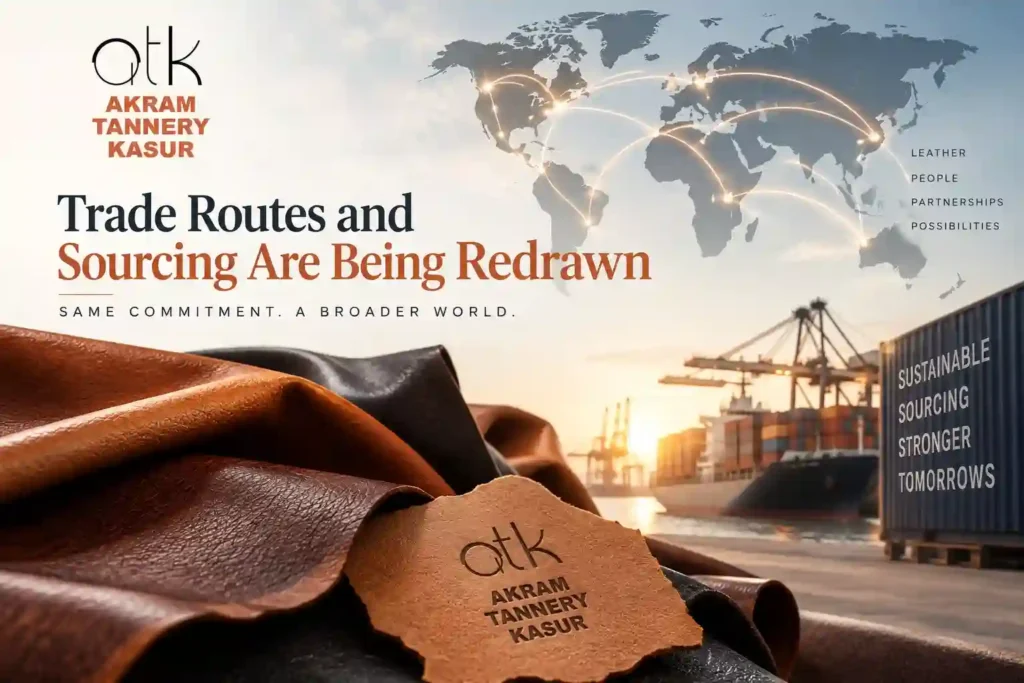
Where leather gets sourced from is shifting almost as much as how it’s made.
China’s traditional dual role as both the world’s largest buyer of raw hides and a dominant exporter of finished leather goods has been disrupted by tariff volatility over the past two years. Reciprocal tariffs that spiked sharply before being partially adjusted created enough uncertainty that many Western brands began actively diversifying their sourcing away from single-country dependence on China, even as Chinese tanneries face renewed pressure on finished leather pricing.
India continues to lead in raw leather production volume, drawing on deep traditional leatherworking expertise, though a fast-growing domestic middle class is creating more competition for hides that would previously have been exported, gradually tightening availability for overseas buyers.
Pakistan has strengthened its position as a reliable alternative sourcing hub. Pakistani tanneries combine decades of tanning expertise with modern processing infrastructure, and typically offer leather at roughly 30–40% lower cost than comparable European sources, without sacrificing quality. Kasur, in particular, has a long-established tannery cluster with export relationships spanning the United States, United Kingdom, Canada, the Gulf states, Australia, Turkey, and the wider European market. Tanneries in the region that have been operating for multiple decades sorting hides by size, grade, and quality; producing everything from vegetable-tanned and crust leather through to finished, embossed, nubuck, pull-up, and woven leather are increasingly the kind of long-term, quality-consistent supplier that brands are actively seeking as they diversify away from single-country risk.
Europe retains its position at the premium end of the market. Italy, France, and Spain continue to command higher prices, underpinned by centuries of tanning heritage, some of the world’s strictest environmental standards, and deep-rooted relationships with luxury houses. For top-tier luxury goods, European leather remains the preferred choice; for mass-market and mid-premium products, Asian sourcing is increasingly the default, purely on cost and scale grounds.
Mexico has emerged as a strategic nearshoring option for U.S. buyers, thanks to preferential USMCA tariff treatment on qualifying leather goods, shorter lead times, and lower logistics complexity compared with sourcing across the Pacific.
The overall picture is one of deliberate diversification. Buyers who relied heavily on a single country or a single supplier are re-learning, in real time, why that concentration is risky and are actively building relationships across two, three, or more sourcing regions to hedge against the next tariff shock or regulatory shift.
Synthetic and Alternative Leathers: Complement, Not Replacement
Alternative and synthetic leathers are growing quickly the artificial leather market alone is now valued in the tens of billions of dollars and expanding steadily across furniture, footwear, automotive, and luggage applications, while bio-based and lab-grown leather alternatives are attracting rising investment on the back of ESG-driven demand. Synthetic leather now accounts for a meaningful and growing share of overall market volume, typically priced at roughly a third of the cost of genuine animal leather.
But the more accurate read of 2026 is not “synthetic replacing genuine leather” it’s segmentation. Synthetics are winning in cost-sensitive, high-volume applications where consistent supply and predictable pricing matter more than provenance or long-term durability. Genuine leather and specifically well-documented, sustainably tanned genuine leather continues to hold its ground and, in many premium categories, is gaining share, precisely because raw hide scarcity and rising sustainability standards make authentic leather feel more exclusive, not less relevant. Brands are increasingly making these decisions product-by-product: synthetic materials for a budget accessory line, genuine vegetable-tanned or finished leather for anything positioned as premium, durable, or heritage-driven.
What This Means for Buyers and Brands in 2026
Given everything reshaping the market this year, a few strategic priorities stand out for anyone sourcing leather whether for footwear, automotive interiors, upholstery, or fashion accessories.
Diversify your supplier base across regions. Single-country sourcing is now a structural vulnerability, not just a theoretical risk. Spreading orders across established tanneries in Pakistan, India, Europe, and nearshore options like Mexico provides real protection against the next round of tariffs, export restrictions, or regional supply disruption and it gives buyers negotiating leverage they simply don’t have with one supplier.
Verify certifications before you need them, not after. LWG ratings, ISO 14001 environmental management, REACH compliance, and documented traceability systems are quickly becoming the price of entry for supplying major retailers and automotive OEMs. Waiting until a retailer asks for documentation is too late; pre-qualifying suppliers on these credentials should happen at the start of any sourcing relationship.
Lock in supply relationships rather than buying spot. With hide availability constrained and pricing volatile, buyers who commit to volume agreements and longer-term partnerships with established tanneries are far better positioned than those chasing the lowest spot price each season. Suppliers facing genuine scarcity will naturally prioritize the customers they know they can count on.
Budget for structurally higher costs. The projected price increases aren’t a temporary blip tied to one bad harvest or one policy cycle they reflect a genuine supply constraint layered on top of rising compliance costs. Brands need to plan pricing, margins, and product mix around a “new normal” that includes higher input costs for the next several years.
Evaluate alternative materials strategically, not defensively. Synthetic and bio-based leathers have a real and growing place in the market, but substituting them wholesale in categories where customers expect genuine leather’s durability, breathability, and aging characteristics risks brand damage. The smarter approach is product-by-product evaluation based on performance needs and positioning.
Treat supplier relationships as risk management, not just procurement. In a market defined by scarcity, tanneries allocate limited premium hides and capacity to the partners they trust buyers with a track record of reliable communication, fair payment terms, and consistent order volume. That reputation is built well before a shortage hits, not during one.
Looking Ahead
The global leather industry heading through 2026 and into 2027 is defined by a genuine paradox: demand for leather real, tanned, animal-hide leather is as strong as it has been in years, even as the raw material underpinning that demand becomes scarcer and more expensive to produce responsibly. That tension is forcing a level of professionalization across the supply chain that the industry hasn’t seen before: better traceability, stronger environmental compliance, more diversified sourcing, and closer, longer-term relationships between tanneries and the brands they supply.
For manufacturers who have already built the infrastructure to meet this moment established water treatment and chrome-free processing capability, decades of hide-sorting and grading expertise, a track record of consistent export quality across vegetable-tanned, crust, finished, embossed, nubuck, pull-up, and upholstery leather 2026 looks less like a crisis and more like a genuine opportunity to become the reliable, documented, long-term partner that global brands are actively searching for. Buyers who move early to build those relationships, verify certifications, and diversify their sourcing base will be the ones who secure quality leather at reasonable, predictable terms while competitors scramble to catch up.
Frequently Asked Questions
Why is leather getting more expensive in 2026?
Prices are rising mainly because of a genuine raw hide shortage U.S. cattle herds are at their smallest size since the 1950s, and hide supply doesn’t respond to leather demand the way a normal commodity would, since ranchers raise cattle for meat, not hides. Add in tariff pressure on major sourcing countries, higher freight costs, and rising environmental compliance costs at tanneries, and analysts are projecting roughly 22% price increases through 2026–2027, settling into a longer-term increase of around 7%.
Is genuine leather being replaced by synthetic alternatives?
Not really the market is segmenting rather than substituting. Synthetic and bio-based leathers are growing quickly in cost-sensitive, high-volume categories like budget footwear and fast fashion, while genuine, well-documented leather is holding or gaining ground in premium and heritage categories, where durability, breathability, and authentic aging still matter to the customer. For a closer look at how modern tanneries are keeping genuine leather competitive on quality, see how modern tanneries maintain leather quality from start to finish.
What certifications should I look for when sourcing leather in 2026?
At minimum, look for Leather Working Group (LWG) certification, ISO 14001 environmental management, and REACH compliance documentation, along with a supplier that can show traceability from hide origin through tanning and finishing. Major retailers and automotive OEMs are increasingly requiring this documentation before they’ll even list or approve a supplier, so it’s worth pre-qualifying suppliers on these credentials early. Our guide on evaluating a leather supplier before placing your first order walks through the full checklist.
Which countries are the best sources for leather right now?
It depends on what you need. Pakistan offers strong quality at roughly 30–40% lower cost than Europe, with decades of tanning expertise concentrated in hubs like Kasur. India leads in raw production volume. Europe particularly Italy and France remains the top choice for ultra-premium leather goods. Mexico is attractive for U.S. buyers thanks to USMCA tariff advantages. Most experienced buyers in 2026 are diversifying across two or more of these regions rather than relying on a single source.
What’s the difference between vegetable-tanned, crust, and finished leather?
Vegetable-tanned leather is tanned using natural tannins from tree bark and plant matter rather than chrome salts, producing a firmer, more natural-looking leather that ages well over time see our vegetable-tanned leather range for examples. Crust leather is leather that has been tanned but not yet finished essentially a semi-finished stage, available dyed or in natural white, sorted by size and grade (browse our crust leather options). Finished leather has completed the full dyeing, buffing, and coating process and is ready for direct use in footwear, bags, upholstery, or accessories see our finished leather collection.
How can I reduce the risk of leather supply disruptions in my business?
Diversify your supplier base across multiple regions instead of relying on one country, lock in longer-term supply agreements rather than buying spot, verify sustainability certifications before you need them, and build a genuine relationship with your tannery rather than treating sourcing as a purely transactional purchase. Suppliers facing real material scarcity naturally prioritize the buyers they trust and know best.